I love the Terrapin half course.
Nowhere else I know has such variety-demanding climbs, long technical descents, incredible views, water crossings, and plenty of boulders-all in such a short course.
The first time I ran this course was in 2012. I had just started running and really had no idea what I was doing. The next two years, I ran the 50K race. And last year, I did the half course with two ladies doing it as their first trail race-we were not racing at all, but enjoying the day and taking lots of photos.
Since running Hellgate a few months ago, I've been just running for fun. I've stayed in shape but haven't trained rigidly like I do before big goal races. Still, I thought it would be fun to try to beat younger me. My 2012 time was 3:22. I was hoping to do it in 3:20 this year. Our last training run was closer to 3:30, but we weren't racing and there were a few places we had stopped for pictures, so I was hoping to be able to make up the time.
The morning started off comfortably cool, in the lower 40s. As we stood around checking in and waiting for the prerace briefing to start, it seemed to be getting colder. I changed into my cold weather contingency clothes, switching out shorts for capris and my tank top for a long sleeved shirt, plus my prized Hellgate jacket. I was wearing a pack, but without the hydration bladder, mostly just for the convenience of pockets for snacks and my Salomon soft flask, plus the option of stashing my 12oz water bottle when I needed my hands.
Soon we lined up near the start, and the gong sounded-what a great way to start a race! We all headed out down the road. It was about 15 minutes before sunrise and there was just enough light to run up the road without headlamps. Several friends were nearby and it was nice to start out together. My first goal of the day was to run the first mile without walking. It's mostly flat or slightly uphill, and followed by a long climb, so I wanted to get some running in while I could. I made that goal, and finished the first mile in 10:30. Then we set in to run/walk (well, mostly walk) the long climb up to Camping Gap. There were still a lot of people close together, which made the climb go by relatively quickly. The sun came up and it was a beautiful morning to be out. I started to feel warm at a few points up the climb and wondered if I had overdressed. Before I knew it, we were taking the hard right turn off the fire road and arriving at Camping Gap at 1:02. I was very pleased with that time, knowing it was several minutes faster than we had done on the training run and I was still feeling good. The aid station crew there was great, very cheerful and helpful.
From there it was on to the toughest part of the climb, the better part of a mile up to the Terrapin summit. This part is always tough on the legs, but every time I climb it, whether training runs or races, it does seem to get a bit easier, if only because it gets more familiar. Even though it felt like forever, it actually took less than 20 minutes to get to the summit. There was a line at the bib punch and I had to wait for 5-6 people to punch their bibs, but it was nice to rest for a few minutes and catch my breath.
From there, we ran along the ridges towards Fat Man's Misery. It was nice to be able to stretch the legs out a bit in between rocky patches, and remember what it's like to run instead of just climb. Now I was not only glad I'd chosen the long sleeves, I started to wish I had added gloves. Before long, we were at Fat Man's Misery. Once again, a bit of a traffic jam. I was pretty tickled to have to wait; when I ran it as a 50K, or ran/hiked last year, I was pretty far behind the pack by this point and had it all to myself. I was quite flattered that I was in the mid-pack still at this point in the race. It didn't take long and we were all through and back on the trail, ready to take on the pounding downhill.
There are a LOT of rocks in this section, and it's very steep. I tried to run hard enough to push myself, but still concentrate on not tripping. Going through the rock garden, I found myself wishing someone would come and paint a few rocks that wouldn't move as you stepped on them so I'd know where to step. The part afterwards feels especially precarious, and is the most challenging section of the course to me, when it's so steep that I often find myself sliding down more than running. Thankfully, the recent rain had given the ground a bit more grip than when it's dry and dusty, and my legs were able to just keep up. I arrived at the last aid station at exactly two hours into the race. I was thrilled with that time. I knew I had run the downhill much stronger than I had any previous time on the course, and yet my legs did not feel trashed and I was looking forward to running strong on the last section.
I was trying to remember exactly how long the race was. My watch said I'd only gone a little over 7 miles by this aid station, but I thought it was pretty close to 13 miles. I decided to do my mental math with 6 miles to go. I was hoping to run 6 miles in 80 minutes, which sounded very doable. I started to get excited about beating Younger Me.
My main goal for this section was just to run as hard as I could the whole time. I'd kept that up so far today and wanted to finish knowing I'd really given my all the entire day. If I did that, I'd be happy with any finishing time. Coming in and out of the last aid station, I'd seen many of my running buddies-Ruth, Rhonda, David, Joe, Tim...it was fun to know that we were all having a good day out there. I chased Rhonda down during the first part of this rolling section and chatted with her for a few minutes. I was experiencing Selective Runner Memory, whereby I remembered this section as having much more downhill and much less uphill than it actually had.
Eventually, we did get to the boundary signs about the edge of the forest, and it started to go downhill. Now this was the running I remembered! It really felt glorious to run hard again, after many miles of challenging climbs and treacherous descents. We blazed through the rest of the swoops in and out of the mountain, and through the last big stream crossing. I ran hard down the rocky road, faster than I normally would but feeling confident and strong and trying to eke out the best finish I could. I ran with a few guys during those last few miles and we really pushed each other to keep going strong. Finally, the picnic table! One more mile. No walking now! We came out to the paved road and headed over the bridge. My last miles friends took off here and I couldn't catch them anymore. There's one last hill that's not big, but just large enough to be annoying when the finish line is so close. Then you can see the finish line, only it's still almost half mile away and you have many cows to run past before you get there. Finally, finally, we came around the corner to the gate. Another girl and I turned the corner at the same time and we both turned on the jets for a sprint across the field. And we were done! 3:02. Twenty whole minutes faster than Younger Me. So much better than I had hoped for!! I was thrilled with my time. It was a great day out there!
The best prize of all was finishing before the freezing rain and snow began. The 50Kers and slower half marathoners definitely had a tougher day as far as weather conditions. Hats off to them.
It was great to watch so many friends finish. Lots of us had set PRs for the course, and everyone seemed to have a good experience out there. We enjoyed a delicious post-race meal of bbq sandwiches, and as icing on the cake, I won a pair of socks in the giveaway.
All in all, it was a magnificent day on the mountain. Can't wait to come back next year and try to break that three hour mark!
Sunday, March 20, 2016

Sunday, December 13, 2015
(Hotter than) Hellgate 100K - December 12, 2015
Hellgate 100K is a "special" race, no matter who you ask. Every year I try to run one race that I don't think I can finish, to push myself to train harder and run smarter. Many of my friends entered the Beast series this year, and a few others who were interested in the race, so I put in my application for Hellgate-misery loves company right? Much to my surprise, Dr. Horton (aka "the race committee") selected my application and I was in. The race has intrigued me for years, and other than Holiday Lake, I haven't run many winter races. It sounded like an insanely hard challenge and I honestly gave myself about 50-50 odds of finishing, if I was able to train the way I hoped and the weather cooperated.
Well, training did not go as I had hoped. Scheduling conflicts, various injuries, sickness-it seemed like every week there was something that caused me to miss a workout, or shorten a long run, or cut out my speed work. Part of what I love about ultrarunning is that your success depends in large part on how you handle challenges that come your way, both in training and on race day. Overcoming obstacles is at least as important, if not moreso, than your athletic ability. Even so, when race day arrived I was feeling unprepared. I felt like I had only reached about 80% of the fitness level I was aiming for. And there was a large section of the course (Floyd's Field to Bearwallow) that I hadn't been able to see, because Dr. Horton had a bike wreck and had to cancel that training run on short notice.
Leading up to the race, the weather forecast got warmer and warmer. I was very thankful for this honestly. My biggest fear about Hellgate was getting "Hellgate eyes", which sounded absolutely awful. Personally, I'd rather deal with a warm day than frozen eyeballs, so I was grateful for the "Sissygate" forecast.
Friday night, Melissa picked up me and Alissa and a month's worth of food and drinks, and we drove up to the camp. Melissa would be crewing both me and Alissa for the race. We drove up to arrive at 8:00 for the race briefing, but in his excitement Dr. Horton had started the meeting early and we walked in just in time to hear, "Well, that's all my points..." Oh well.
We spent some time visiting with other runners, the nervous excitement thick and everyone trying to occupy the time before we drove to the start. I talked to people, and then around 10:00 I started gathering up my pack and supplies, double-checking that I had everything I needed and nothing I didn't think was worth carrying for 66 miles. Knowing it would be warm, I decided to keep the bladder in my pack filled with tailwind, and I also used an 8oz softflask so I could grab a second type of drink from the aid stations. I had a few snacks, my mp3 player, my index cards with notes about the course sections and my goal times, and gloves. It wasn't cold yet, but I thought that when we got higher up in elevation later in the night that I would probably want them.
10:40 finally arrived, and there was a burst of frenetic activity as everyone grabbed their race supplies and squeezed into the caravan of vehicles driving to the start. The bank at Natural Bridge said the temperature was 46 degrees as we drove by. It was nice that we could stand outside before the start and not freeze. I had a lot of thoughts along the lines of, "What am I thinking?" which is typical for me at a race start.

We all gathered at the start line, and Dr. Horton counted down to GO. We all took off, to the cheers of the other runners and crew who were there. Here we go!!
Start to AS1 (FSR 35) 0:48
It was very warm at the start, and I appreciated that my legs didn't feel stiff or numb like they usually do at the beginning of a cold run. I worked hard on staying in the pack of runners and not just drifting to the back like I usually do. I knew from the training run that none of the hills here were steep or long, so I ran as much as possible. On the downhills, I was feeling strong and passed quite a few people. I was happy to bank some time where I could. The miles went by pretty quickly here. I chatted with other runners, enjoyed the commentary about the stench of the water in the creek, and pushed myself. Even though I arrived at the first aid station a few minutes after my goal, I was pleased, because I was still in a big pack of people and I was feeling strong.
AS1 (FSR 35) to AS2 (Petites Gap) 1:46
This section is a long uphill road. I focused on run/walking the whole way up, counting my steps to run for a long section, then walk just enough to recover. Knowing there are a lot of uphill roads in this race, I had tried to train on running uphill roads, so I feel like this is one place my training did help. I made decent time up the road and was pleased with how my legs were feeling so far. At Petites, I got to see Melissa for the first time. She helped me fill up quickly and head back out on the trail. Familiar faces are such a boost in ultras!
AS2 (Petites Gap) to AS 3 (Camping Gap) 3:28
Leaving Petites, we had a short downhill section. I was nervous about the rocks and things under the leaves, but I was able to stay close enough behind some other runners to watch their footing and use that to my advantage. I think I made better time on the downhill part here than during the training run. After that, there is a section of single track that goes uphill. This was the first part (but definitely not the last) that seemed to take forever. I kept watching for the road that I know leads up to Camping Gap. Finally, we reached it and did the long climb. Once again, I pushed myself to run/walk as much as possible, with short walking breaks in between longer sections of running. As much as I wanted to walk, my legs were feeling strong still and I knew I had to hussle to make my 6 hour goal. The Camping Gap aid station was a welcome site, and I made sure to take a minute there to drink a lot, and take some food with me, since the next section is the longest between aid stations.
AS3 (Camping Gap) to AS 4 (Headforemost Mountain) 6:01
The first few miles of this section are pretty runnable, and once again I tried to push myself to run as much as possible. It wasn't easy; I had some stomach issues here, and some cramps. I was losing my mind a little bit in here too-maybe the fatigue/sleep deprivation, maybe the hours of night running, I'm not sure. But I saw many many pairs of eyes in the woods just off the trail, heard many large animals, and saw a few people sitting on logs on the side of the trail. I'm pretty sure none of them were real. I expected this to be the section where it got cold, but it never did, and the grassy road section known for its fierce wind many years was completely still.
My first year of running ultras, I would go out way too fast and then hit a wall in the second half. But as I learned to pace myself, I think I tend to err on the side of caution, and don't run as hard as I often could. Holiday Lake this year I used as an experiment. I ran as hard as I could for as long as I could to see what would happen. And honestly, it wasn't until the last climb in that race, a little over a mile to go, that I reached the point of not being able to run.
I was thinking about that as I ran here. I knew that Hellgate would be a tough race, and I wasn't sure I could finish. But if I was going to miss a cutoff, I wanted to know that I had pushed myself the whole way, so there would be no wondering if I could have done better. With that in mind, I hauled tail the entire way up the mountain. And I arrived at 6:01! Honestly, I was thrilled. That was faster than we had run on the training run and I still felt good. Melissa was at Headforemost, but she was still helping other runners, not expecting me to arrive yet. That made me smile. :) I filled my pack with more tailwind and drank more ginger ale, grabbed some food, and headed out.
AS4 (Headforemost Mountain) to AS5 (Jennings Creek) 7:28
I was looking forward to this section and I was scared of this section at the same time. I was nervous because this began the section I had never seen, and going into the race I was pretty confident that I would make it through the Headforemost Mountain cutoff, that it was the second portion of the race and the Bearwallow cutoff I was concerned about. At the same time, I knew that Jennings Creek was the breakfast aid station, which I was excited about, and every race report talked about running DOWN to Jennings Creek, which after doing mostly climbing for the last 6 hours, sounded amazing. You can imagine my disappointment when the first section turned out to be a climb! Thankfully, it was short, and after that we did indeed run down most of the way to Jennings Creek. Shortly after the aid station we passed an elderly man hiking uphill in the dark with two walking sticks. That startled me, and I wondered if I had imagined him too until I confirmed with another runner that she also saw him. Strange.
I was glad to have read race reports about this section, because after about 2 miles I caught site of the aid station down the mountain, and it sure seemed like we would be there soon. But we weren't. We wandered around and around the mountain, in every direction possible except for towards the aid station. Still, the footing was good, the trails were nice, and I was able to run almost the entire section. The sun came up here, and I underestimated the mental boost that would give me today. I felt like a brand new person. I was running well, running downhill (which helps me feel like superwoman anyway), enjoying the trails, and now the sun was up and I could see the beautiful mountains we were in. This section was a real highlight of the race for me. I entered it exhausted and nervous, but then I got to Jennings Creek 20 minutes ahead of when I expect to be there, and at Jennings Creek there was bacon! Oh happy day! When I came in to the aid station, Alissa was still there, and she was looking pretty good at that point. I was quite proud of myself for catching up to her, because she is a very strong runner. Melissa made sure we both got what we needed. I stopped to drink a lot at the aid station again, and took some bacon and hash browns to go.
AS5 (Jennings Creek) to AS 6 (Little Cove) 9:18
For the first time in the race, I started to relax a little bit. Knowing I had just banked 20 minutes was huge-now I felt like if I had to stop and pee, I could, without worrying about that making the difference at the cutoff. This section was a really pretty section-it started off with a long road climb with beautiful views off to the side. I pushed myself to continue the run/walk plan up the hill. After the gate, we started on a single track trail downhill, and then before I knew it there was a road going downhill. This was a perfect running road-compacted dirt and gravel, and a wonderful downhill angle. I felt amazing running down this road, and for the first time all day began to believe I might actually finish the race. I was a little sad to turn off the road onto another trail! Eventually we reached the bottom and made the turn onto Yellowstone Road, which begins the long road climb up to Little Cove. I continued to run/walk, although my walking breaks were getting a little longer at this point and it was getting harder to push myself. This section felt pretty long, and I was so happy to finally see the aid station! And when I looked at the time, I was thrilled. I had banked another 15 minutes against my goals. Never did I think I would be so far ahead of my goal pace. The cutoff at Bearwallow didn't seem nearly so intimidating. I just needed to keep running steady. I drank a lot at the aid station (definitely becoming a theme) and then headed back out towards Bearwallow.
AS 6 (Little Cove) to AS 7 (Bearwallow Gap) 11:32
I knew that my husband was going to try to bring the kids out to Bearwallow. I told him I didn't think there was any way I'd be there before noon, but he said they'd get there around 11:30 so my son could help with drop bags (his favorite thing to do at aid stations). As I went through this section, I realized there was a chance I could beat him to Bearwallow. I felt bad that I had no way of letting him know, but fairly proud of myself at the same time. I was really having a great day. I was even having fun!
My notes said that the first mile out of Little Cove was runnable downhill, but once again, it started out climbing. The climb was short though, and then the trail did indeed go downhill. This was a very pretty section of single track and grassy trail. I was nervously awaiting the so-called "devil trail", which I knew led into Bearwallow. A few times I'd go through a rocky section of single track and wonder if this was already it, and then it would smooth out. At one point we made a turn onto a trail and that trail was noticeably more rocky. Here we are, I thought. This was a pretty tough section of trail. I saw a few people fall, and I took a hard fall myself. Thankfully nothing was bleeding or badly bruised and I was able to keep going. The last quarter mile or so was such a tease; we had crossed the road and I could see the sign for the entrance to the parking lot, but then we wandered around in zig zags every which way before we actually entered the parking lot.
I was beyond excited to arrive when I did. Melissa and Kathie were there, and helped me change my socks, get food, refill my pack, etc. Can I just say that having a crew is an amazing gift! The aid station volunteers are wonderful, and we couldn't do these races without them. But there's something special about having friends out there supporting you personally on these crazy endeavors. I asked Melissa to tell Jeremy I'd already been through so he wouldn't keep waiting, and to tell him I'm so sorry I missed him! Then it was back to the trail, uphill of course.
AS 7 (Bearwallow Gap) to AS 8 (Bobblets Gap) 13:26
As always, this section had plenty of climbing. I was thankful to have seen it during a training run. This part seems to go on forever, repeating over and over-climb a long uphill around a ridge, turn the corner, run a slight downhill, then turn the other way, repeat. The nice thing is that each climb gets a little less steep, so it sort of feels like you're repeating the same trail, but getting a little stronger each time. My legs were getting tired here, but I kept pushing myself to run wherever I could. I had to back off on the rocky sections because I was starting to stumble a lot-no agility left in my legs. When the footing was good I did push myself to run. The views were very pretty along here, overlooking the valley, although I don't think I enjoyed them as much because I was so tired. Two ladies passed me in this section talking about trying to make their 17 hour finish-were we really on pace for that?? I started to daydream about what that would look like. I kept doing the math, and I would need to average something like a 16 minute mile for the rest of the course, which almost sounded doable at that point. Even short of that, it looked like I would at least avoid the need to sprint a 6 minute mile at the end to make it into the camp on time, and I was very thankful for that.
This section was long, and I was very impatiently awaiting the aid station. Because of the turns in the trail, you can't see or hear the aid station until you're right there. When I came around the corner, my son was there, ringing a cowbell!! And then my daughter ran up! Jeremy was there, and it was so great to see him and the kids. What a huge encouragement! This was another high point in the race for me-I was running very well, almost a full hour ahead of my goals, and my husband and kids were there to see me doing well. Melissa and Alissa (much to my surprise) were at the aid station and helped me get food and something to drink. Blake was working this aid station, and he had a cooler full of ice-amazing!! I drank some ice cold water, and then dumped a bunch of ice into my bra. That helped so much to cool me off, because I was feeling pretty hot at this point. The high ended up being in the mid 70s, and I was running hard and feeling it. I left the aid station with a great sendoff from my family and friends.
AS 8 (Bobblets Gap) to AS 9 (Day Creek) 15:49
The first part of this section is a very washed out road, which I ran/walked because I was no longer nimble enough to hop over the millions of rocks, holes, and ravines that made up the road. Then it opens to a gravel road. I ran the entire road down, and although my legs were definitely tired, I still felt pretty good. As I turned into the single track though, it was like a switch flipped and my body just said, "Aaaand we're done." Suddenly my legs were like lead weights, and I couldn't eat anything anymore, and I was so tired. My tailwind started making me feel thirstier every time I took a sip, so I stopped drinking. By late in this section I was getting very dehydrated and felt like I was on the verge of passing out. I remember promising myself that I would sit in a chair at Day Creek, because at least if I passed out there, there would be people to get me back up and make sure I finished the race. This was the lowest I have ever felt in any race. I was overwhelmed, discouraged, and disappointed. I had run so well up to this point, and now the wheels had fallen off. I wondered why I was out there, and if I should even have attempted this race. It was like the heat, exhaustion, distance, and infamous "forever section" had all twisted into one big nasty black hole and sucked me in. The trail in this section is very disorienting, turning in every direction, and there aren't many landmarks, so it feels like you're making very little progress. At one point, I was pretty certain that I had accidentally looped back and was never actually going to leave the course. My Garmin gave me the low battery beep here, and for awhile I was convinced that it had actually stopped recording because it seemed like it said the same distance every time I looked at it. I considered curling up on the trail and taking a nap. It was not pretty.
At this point, I was so grateful to the previous, strong runner me, who had banked enough time that I could walk and still believe there was time to get to the finish. For the first time all day, I covered miles that took more than 20 minutes. It was very slow and ugly. Mentally, I knew that I still had time to finish, and I knew that quitting was not an option. I would finish. But I hate finishing a race on a death march.
Finally, somehow, I made it to the Day Creek aid station in terrible shape. I mumbled something about needing to sit down and drink a lot of water. I had Melissa dump out the rest of the tailwind in my pack, and fill it with water instead. I took everything out of my pack that I didn't need for the last section. I kept water, salt pills, and one Stinger waffle, hoping I'd be able to eat it (wishful thinking). Alissa was so encouraging, pointing out that I had two hours to cover 6 miles, so even if I walked the whole thing I would make it. They did exactly what I needed then-they let me sit and rest for a few minutes, rehydrate, and then they got me back out on the trail. I was so very thankful to have friends there-the aid station crew is fabulous, but I needed the familiar faces telling me I could do this.
AS 9 (Day Creek) to Finish 17:44
I headed out of the aid station and promptly vomited most of the water I had drank while sitting in the chair. So much for hydration. Too bad, have to keep moving anyway. I slogged up the hill which seemed to be about 700 miles long. I know that in reality, this hill is not that terrible, but I was physically spent at that point. My legs just laughed at me when I considered running. So I trudged along, focusing on taking one step at a time. From the training run, I knew that there was a historical marker shortly before you can see the gate where you cross the parkway at the top of the hill. It seemed like forever, but after about 45 minutes, there was the marker. Hooray, that means we're almost there. A few more minutes of hiking and finally, the gate came into view. I have never been so excited to see a metal gate or hear the sound of traffic!! At the top, there was a most blessed gift, a person with a cooler of ice cold water bottles. That was exactly what I needed in that moment. And I knew that I had three miles to go, they really are all downhill, and I had just over an hour to do them. Even in my sad state, I was pretty confident that I could do that. I was hoping to run most of it, since the footing is pretty decent. But for the first section, there were just enough rocks that I was sure I would slip and fall off the mountain. Plus, when I tried to run, it felt like my legs were about to break off at the hips. So I quick-walked down, and jogged a few steps when I could, until my legs loosened up a bit again. Then I did my same run-walk approach down the hill. Never thought I would be using that on a downhill. Normally I love downhill finishes, but when you have no legs left, downhill can be just as tough as climbing.
Finally, we reached the gravel road section, and I forced myself to jog as much as possible. Even jogging, I was moving pretty slowly, like a 14 minute pace. But I was moving and I was happy to be running again. Many many walking breaks in this section. Not pretty. But forward progress and the finish line was ever so close. As I came down the mountain, I saw Melissa coming up. She was excited to see me, and gave me a last boost of encouragement. I was almost to the 1 mile to go sign, and I still had half an hour. I was really going to do this!!
I ran most of the way until I came up around the side of the camp. I knew that no matter how exhausted I was, once I entered the gates of the camp, I was running to the finish, and I wanted to rest for a minute first! At last, I turned through the gates to the camp. It was dark, and hard to spot the reflective markers, so I was very thankful for the people standing at one particular intersection calling me to come the right way. And then, there it was-that orange tape finishers chute leading to the race clock. As I came up, they asked for my number (it was dark, and my headlamp prevented them from seeing my face). Then Dr. Horton greeted me at the finish with, "WHOA!!!! NO WAY!!! I didn't give you a chance at all to finish!!" That was a pretty great feeling, honestly. Dr. Horton is a legend, and he is really good at predicting what runners will be able to do. Being able to exceed his expectations is a huge achievement.
I stayed at the finish for the next 15 minutes to watch the rest of the runners finish, which worked out well since I could hardly move anyway. There was a big group that came in with about 5 minutes to spare, so exciting to see them beat the clock!! Everyone had suffered that day. The race was no longer Sissygate, it was too hot for that. "Hotter than Hellgate" seemed to be sticking. I was so exhausted that I forgot to get the finish line photo with Dr. Horton, my one regret from this race.
This race was the hardest race I've ever run, with the highest highs and the lowest lows. For awhile I ran a much stronger race than I expected, and then I had a breakdown I never saw coming. I went from being afraid of missing the 12:30pm cutoff, to daydreaming about a 17 hour finish, to slogging ten miles on dead legs. But I finished!! I am so thankful for all the aid station volunteers, for Melissa, who is the most amazing crew ever, for Alissa and Kathie helping me at aid stations, for Jeremy coming out with the kids to see me running, and for Dr. Horton creating this beast of a race and giving me a chance to run it. It certainly was a "special" experience that brought every bit of the challenge promised, even if it wasn't what we expected. I'm so glad I was able to run it!


Well, training did not go as I had hoped. Scheduling conflicts, various injuries, sickness-it seemed like every week there was something that caused me to miss a workout, or shorten a long run, or cut out my speed work. Part of what I love about ultrarunning is that your success depends in large part on how you handle challenges that come your way, both in training and on race day. Overcoming obstacles is at least as important, if not moreso, than your athletic ability. Even so, when race day arrived I was feeling unprepared. I felt like I had only reached about 80% of the fitness level I was aiming for. And there was a large section of the course (Floyd's Field to Bearwallow) that I hadn't been able to see, because Dr. Horton had a bike wreck and had to cancel that training run on short notice.
Leading up to the race, the weather forecast got warmer and warmer. I was very thankful for this honestly. My biggest fear about Hellgate was getting "Hellgate eyes", which sounded absolutely awful. Personally, I'd rather deal with a warm day than frozen eyeballs, so I was grateful for the "Sissygate" forecast.
Friday night, Melissa picked up me and Alissa and a month's worth of food and drinks, and we drove up to the camp. Melissa would be crewing both me and Alissa for the race. We drove up to arrive at 8:00 for the race briefing, but in his excitement Dr. Horton had started the meeting early and we walked in just in time to hear, "Well, that's all my points..." Oh well.
We spent some time visiting with other runners, the nervous excitement thick and everyone trying to occupy the time before we drove to the start. I talked to people, and then around 10:00 I started gathering up my pack and supplies, double-checking that I had everything I needed and nothing I didn't think was worth carrying for 66 miles. Knowing it would be warm, I decided to keep the bladder in my pack filled with tailwind, and I also used an 8oz softflask so I could grab a second type of drink from the aid stations. I had a few snacks, my mp3 player, my index cards with notes about the course sections and my goal times, and gloves. It wasn't cold yet, but I thought that when we got higher up in elevation later in the night that I would probably want them.
10:40 finally arrived, and there was a burst of frenetic activity as everyone grabbed their race supplies and squeezed into the caravan of vehicles driving to the start. The bank at Natural Bridge said the temperature was 46 degrees as we drove by. It was nice that we could stand outside before the start and not freeze. I had a lot of thoughts along the lines of, "What am I thinking?" which is typical for me at a race start.

I had come up with these split goals, based on splits I had found online (thanks Keith Knipling and Darin), and giving my best guess as to how much time I should allow for each section. Now of course, knowing you should run at a 14 minute pace, and actually being able to run at a 14 minute pace, are not the same thing. But I figured I would know throughout the day if I was on track. During the training run, we ran from the start to Headforemost Mountain in 6:07. My first big goal for race day was to be there by 6 hours. My race strategy was basically to run as hard as I could, for as long as I could, run-walking all the hills, and hope to bank enough time that if I hit a rough spot I could recover and still finish.
We all gathered at the start line, and Dr. Horton counted down to GO. We all took off, to the cheers of the other runners and crew who were there. Here we go!!
Start to AS1 (FSR 35) 0:48
It was very warm at the start, and I appreciated that my legs didn't feel stiff or numb like they usually do at the beginning of a cold run. I worked hard on staying in the pack of runners and not just drifting to the back like I usually do. I knew from the training run that none of the hills here were steep or long, so I ran as much as possible. On the downhills, I was feeling strong and passed quite a few people. I was happy to bank some time where I could. The miles went by pretty quickly here. I chatted with other runners, enjoyed the commentary about the stench of the water in the creek, and pushed myself. Even though I arrived at the first aid station a few minutes after my goal, I was pleased, because I was still in a big pack of people and I was feeling strong.
AS1 (FSR 35) to AS2 (Petites Gap) 1:46
This section is a long uphill road. I focused on run/walking the whole way up, counting my steps to run for a long section, then walk just enough to recover. Knowing there are a lot of uphill roads in this race, I had tried to train on running uphill roads, so I feel like this is one place my training did help. I made decent time up the road and was pleased with how my legs were feeling so far. At Petites, I got to see Melissa for the first time. She helped me fill up quickly and head back out on the trail. Familiar faces are such a boost in ultras!
AS2 (Petites Gap) to AS 3 (Camping Gap) 3:28
Leaving Petites, we had a short downhill section. I was nervous about the rocks and things under the leaves, but I was able to stay close enough behind some other runners to watch their footing and use that to my advantage. I think I made better time on the downhill part here than during the training run. After that, there is a section of single track that goes uphill. This was the first part (but definitely not the last) that seemed to take forever. I kept watching for the road that I know leads up to Camping Gap. Finally, we reached it and did the long climb. Once again, I pushed myself to run/walk as much as possible, with short walking breaks in between longer sections of running. As much as I wanted to walk, my legs were feeling strong still and I knew I had to hussle to make my 6 hour goal. The Camping Gap aid station was a welcome site, and I made sure to take a minute there to drink a lot, and take some food with me, since the next section is the longest between aid stations.
AS3 (Camping Gap) to AS 4 (Headforemost Mountain) 6:01
The first few miles of this section are pretty runnable, and once again I tried to push myself to run as much as possible. It wasn't easy; I had some stomach issues here, and some cramps. I was losing my mind a little bit in here too-maybe the fatigue/sleep deprivation, maybe the hours of night running, I'm not sure. But I saw many many pairs of eyes in the woods just off the trail, heard many large animals, and saw a few people sitting on logs on the side of the trail. I'm pretty sure none of them were real. I expected this to be the section where it got cold, but it never did, and the grassy road section known for its fierce wind many years was completely still.
My first year of running ultras, I would go out way too fast and then hit a wall in the second half. But as I learned to pace myself, I think I tend to err on the side of caution, and don't run as hard as I often could. Holiday Lake this year I used as an experiment. I ran as hard as I could for as long as I could to see what would happen. And honestly, it wasn't until the last climb in that race, a little over a mile to go, that I reached the point of not being able to run.
I was thinking about that as I ran here. I knew that Hellgate would be a tough race, and I wasn't sure I could finish. But if I was going to miss a cutoff, I wanted to know that I had pushed myself the whole way, so there would be no wondering if I could have done better. With that in mind, I hauled tail the entire way up the mountain. And I arrived at 6:01! Honestly, I was thrilled. That was faster than we had run on the training run and I still felt good. Melissa was at Headforemost, but she was still helping other runners, not expecting me to arrive yet. That made me smile. :) I filled my pack with more tailwind and drank more ginger ale, grabbed some food, and headed out.
AS4 (Headforemost Mountain) to AS5 (Jennings Creek) 7:28
I was looking forward to this section and I was scared of this section at the same time. I was nervous because this began the section I had never seen, and going into the race I was pretty confident that I would make it through the Headforemost Mountain cutoff, that it was the second portion of the race and the Bearwallow cutoff I was concerned about. At the same time, I knew that Jennings Creek was the breakfast aid station, which I was excited about, and every race report talked about running DOWN to Jennings Creek, which after doing mostly climbing for the last 6 hours, sounded amazing. You can imagine my disappointment when the first section turned out to be a climb! Thankfully, it was short, and after that we did indeed run down most of the way to Jennings Creek. Shortly after the aid station we passed an elderly man hiking uphill in the dark with two walking sticks. That startled me, and I wondered if I had imagined him too until I confirmed with another runner that she also saw him. Strange.
I was glad to have read race reports about this section, because after about 2 miles I caught site of the aid station down the mountain, and it sure seemed like we would be there soon. But we weren't. We wandered around and around the mountain, in every direction possible except for towards the aid station. Still, the footing was good, the trails were nice, and I was able to run almost the entire section. The sun came up here, and I underestimated the mental boost that would give me today. I felt like a brand new person. I was running well, running downhill (which helps me feel like superwoman anyway), enjoying the trails, and now the sun was up and I could see the beautiful mountains we were in. This section was a real highlight of the race for me. I entered it exhausted and nervous, but then I got to Jennings Creek 20 minutes ahead of when I expect to be there, and at Jennings Creek there was bacon! Oh happy day! When I came in to the aid station, Alissa was still there, and she was looking pretty good at that point. I was quite proud of myself for catching up to her, because she is a very strong runner. Melissa made sure we both got what we needed. I stopped to drink a lot at the aid station again, and took some bacon and hash browns to go.
AS5 (Jennings Creek) to AS 6 (Little Cove) 9:18
For the first time in the race, I started to relax a little bit. Knowing I had just banked 20 minutes was huge-now I felt like if I had to stop and pee, I could, without worrying about that making the difference at the cutoff. This section was a really pretty section-it started off with a long road climb with beautiful views off to the side. I pushed myself to continue the run/walk plan up the hill. After the gate, we started on a single track trail downhill, and then before I knew it there was a road going downhill. This was a perfect running road-compacted dirt and gravel, and a wonderful downhill angle. I felt amazing running down this road, and for the first time all day began to believe I might actually finish the race. I was a little sad to turn off the road onto another trail! Eventually we reached the bottom and made the turn onto Yellowstone Road, which begins the long road climb up to Little Cove. I continued to run/walk, although my walking breaks were getting a little longer at this point and it was getting harder to push myself. This section felt pretty long, and I was so happy to finally see the aid station! And when I looked at the time, I was thrilled. I had banked another 15 minutes against my goals. Never did I think I would be so far ahead of my goal pace. The cutoff at Bearwallow didn't seem nearly so intimidating. I just needed to keep running steady. I drank a lot at the aid station (definitely becoming a theme) and then headed back out towards Bearwallow.
AS 6 (Little Cove) to AS 7 (Bearwallow Gap) 11:32
I knew that my husband was going to try to bring the kids out to Bearwallow. I told him I didn't think there was any way I'd be there before noon, but he said they'd get there around 11:30 so my son could help with drop bags (his favorite thing to do at aid stations). As I went through this section, I realized there was a chance I could beat him to Bearwallow. I felt bad that I had no way of letting him know, but fairly proud of myself at the same time. I was really having a great day. I was even having fun!
My notes said that the first mile out of Little Cove was runnable downhill, but once again, it started out climbing. The climb was short though, and then the trail did indeed go downhill. This was a very pretty section of single track and grassy trail. I was nervously awaiting the so-called "devil trail", which I knew led into Bearwallow. A few times I'd go through a rocky section of single track and wonder if this was already it, and then it would smooth out. At one point we made a turn onto a trail and that trail was noticeably more rocky. Here we are, I thought. This was a pretty tough section of trail. I saw a few people fall, and I took a hard fall myself. Thankfully nothing was bleeding or badly bruised and I was able to keep going. The last quarter mile or so was such a tease; we had crossed the road and I could see the sign for the entrance to the parking lot, but then we wandered around in zig zags every which way before we actually entered the parking lot.
I was beyond excited to arrive when I did. Melissa and Kathie were there, and helped me change my socks, get food, refill my pack, etc. Can I just say that having a crew is an amazing gift! The aid station volunteers are wonderful, and we couldn't do these races without them. But there's something special about having friends out there supporting you personally on these crazy endeavors. I asked Melissa to tell Jeremy I'd already been through so he wouldn't keep waiting, and to tell him I'm so sorry I missed him! Then it was back to the trail, uphill of course.
AS 7 (Bearwallow Gap) to AS 8 (Bobblets Gap) 13:26
As always, this section had plenty of climbing. I was thankful to have seen it during a training run. This part seems to go on forever, repeating over and over-climb a long uphill around a ridge, turn the corner, run a slight downhill, then turn the other way, repeat. The nice thing is that each climb gets a little less steep, so it sort of feels like you're repeating the same trail, but getting a little stronger each time. My legs were getting tired here, but I kept pushing myself to run wherever I could. I had to back off on the rocky sections because I was starting to stumble a lot-no agility left in my legs. When the footing was good I did push myself to run. The views were very pretty along here, overlooking the valley, although I don't think I enjoyed them as much because I was so tired. Two ladies passed me in this section talking about trying to make their 17 hour finish-were we really on pace for that?? I started to daydream about what that would look like. I kept doing the math, and I would need to average something like a 16 minute mile for the rest of the course, which almost sounded doable at that point. Even short of that, it looked like I would at least avoid the need to sprint a 6 minute mile at the end to make it into the camp on time, and I was very thankful for that.
This section was long, and I was very impatiently awaiting the aid station. Because of the turns in the trail, you can't see or hear the aid station until you're right there. When I came around the corner, my son was there, ringing a cowbell!! And then my daughter ran up! Jeremy was there, and it was so great to see him and the kids. What a huge encouragement! This was another high point in the race for me-I was running very well, almost a full hour ahead of my goals, and my husband and kids were there to see me doing well. Melissa and Alissa (much to my surprise) were at the aid station and helped me get food and something to drink. Blake was working this aid station, and he had a cooler full of ice-amazing!! I drank some ice cold water, and then dumped a bunch of ice into my bra. That helped so much to cool me off, because I was feeling pretty hot at this point. The high ended up being in the mid 70s, and I was running hard and feeling it. I left the aid station with a great sendoff from my family and friends.
AS 8 (Bobblets Gap) to AS 9 (Day Creek) 15:49
The first part of this section is a very washed out road, which I ran/walked because I was no longer nimble enough to hop over the millions of rocks, holes, and ravines that made up the road. Then it opens to a gravel road. I ran the entire road down, and although my legs were definitely tired, I still felt pretty good. As I turned into the single track though, it was like a switch flipped and my body just said, "Aaaand we're done." Suddenly my legs were like lead weights, and I couldn't eat anything anymore, and I was so tired. My tailwind started making me feel thirstier every time I took a sip, so I stopped drinking. By late in this section I was getting very dehydrated and felt like I was on the verge of passing out. I remember promising myself that I would sit in a chair at Day Creek, because at least if I passed out there, there would be people to get me back up and make sure I finished the race. This was the lowest I have ever felt in any race. I was overwhelmed, discouraged, and disappointed. I had run so well up to this point, and now the wheels had fallen off. I wondered why I was out there, and if I should even have attempted this race. It was like the heat, exhaustion, distance, and infamous "forever section" had all twisted into one big nasty black hole and sucked me in. The trail in this section is very disorienting, turning in every direction, and there aren't many landmarks, so it feels like you're making very little progress. At one point, I was pretty certain that I had accidentally looped back and was never actually going to leave the course. My Garmin gave me the low battery beep here, and for awhile I was convinced that it had actually stopped recording because it seemed like it said the same distance every time I looked at it. I considered curling up on the trail and taking a nap. It was not pretty.
At this point, I was so grateful to the previous, strong runner me, who had banked enough time that I could walk and still believe there was time to get to the finish. For the first time all day, I covered miles that took more than 20 minutes. It was very slow and ugly. Mentally, I knew that I still had time to finish, and I knew that quitting was not an option. I would finish. But I hate finishing a race on a death march.
Finally, somehow, I made it to the Day Creek aid station in terrible shape. I mumbled something about needing to sit down and drink a lot of water. I had Melissa dump out the rest of the tailwind in my pack, and fill it with water instead. I took everything out of my pack that I didn't need for the last section. I kept water, salt pills, and one Stinger waffle, hoping I'd be able to eat it (wishful thinking). Alissa was so encouraging, pointing out that I had two hours to cover 6 miles, so even if I walked the whole thing I would make it. They did exactly what I needed then-they let me sit and rest for a few minutes, rehydrate, and then they got me back out on the trail. I was so very thankful to have friends there-the aid station crew is fabulous, but I needed the familiar faces telling me I could do this.
AS 9 (Day Creek) to Finish 17:44
I headed out of the aid station and promptly vomited most of the water I had drank while sitting in the chair. So much for hydration. Too bad, have to keep moving anyway. I slogged up the hill which seemed to be about 700 miles long. I know that in reality, this hill is not that terrible, but I was physically spent at that point. My legs just laughed at me when I considered running. So I trudged along, focusing on taking one step at a time. From the training run, I knew that there was a historical marker shortly before you can see the gate where you cross the parkway at the top of the hill. It seemed like forever, but after about 45 minutes, there was the marker. Hooray, that means we're almost there. A few more minutes of hiking and finally, the gate came into view. I have never been so excited to see a metal gate or hear the sound of traffic!! At the top, there was a most blessed gift, a person with a cooler of ice cold water bottles. That was exactly what I needed in that moment. And I knew that I had three miles to go, they really are all downhill, and I had just over an hour to do them. Even in my sad state, I was pretty confident that I could do that. I was hoping to run most of it, since the footing is pretty decent. But for the first section, there were just enough rocks that I was sure I would slip and fall off the mountain. Plus, when I tried to run, it felt like my legs were about to break off at the hips. So I quick-walked down, and jogged a few steps when I could, until my legs loosened up a bit again. Then I did my same run-walk approach down the hill. Never thought I would be using that on a downhill. Normally I love downhill finishes, but when you have no legs left, downhill can be just as tough as climbing.
Finally, we reached the gravel road section, and I forced myself to jog as much as possible. Even jogging, I was moving pretty slowly, like a 14 minute pace. But I was moving and I was happy to be running again. Many many walking breaks in this section. Not pretty. But forward progress and the finish line was ever so close. As I came down the mountain, I saw Melissa coming up. She was excited to see me, and gave me a last boost of encouragement. I was almost to the 1 mile to go sign, and I still had half an hour. I was really going to do this!!
I ran most of the way until I came up around the side of the camp. I knew that no matter how exhausted I was, once I entered the gates of the camp, I was running to the finish, and I wanted to rest for a minute first! At last, I turned through the gates to the camp. It was dark, and hard to spot the reflective markers, so I was very thankful for the people standing at one particular intersection calling me to come the right way. And then, there it was-that orange tape finishers chute leading to the race clock. As I came up, they asked for my number (it was dark, and my headlamp prevented them from seeing my face). Then Dr. Horton greeted me at the finish with, "WHOA!!!! NO WAY!!! I didn't give you a chance at all to finish!!" That was a pretty great feeling, honestly. Dr. Horton is a legend, and he is really good at predicting what runners will be able to do. Being able to exceed his expectations is a huge achievement.
I stayed at the finish for the next 15 minutes to watch the rest of the runners finish, which worked out well since I could hardly move anyway. There was a big group that came in with about 5 minutes to spare, so exciting to see them beat the clock!! Everyone had suffered that day. The race was no longer Sissygate, it was too hot for that. "Hotter than Hellgate" seemed to be sticking. I was so exhausted that I forgot to get the finish line photo with Dr. Horton, my one regret from this race.
This race was the hardest race I've ever run, with the highest highs and the lowest lows. For awhile I ran a much stronger race than I expected, and then I had a breakdown I never saw coming. I went from being afraid of missing the 12:30pm cutoff, to daydreaming about a 17 hour finish, to slogging ten miles on dead legs. But I finished!! I am so thankful for all the aid station volunteers, for Melissa, who is the most amazing crew ever, for Alissa and Kathie helping me at aid stations, for Jeremy coming out with the kids to see me running, and for Dr. Horton creating this beast of a race and giving me a chance to run it. It certainly was a "special" experience that brought every bit of the challenge promised, even if it wasn't what we expected. I'm so glad I was able to run it!

Thursday, June 12, 2014
Old Dominion 100
Why This Race?
The Course
Pre-race Preparation
Race Day(s)
My crew filled up my water and snacks for the trail section ahead, and whisked me out so quickly that I left without my camera. This got to me a little bit; I had been excited about filming portions of the trail along the way especially to show my kids, and I knew this was a technical trail section with creek crossings that would be really interesting to see. I had to make some intentional mental choices to move past it, especially since I was far enough into the race to start feeling some fatigue. This section was tough, a lot of long climbs, some thick mud, a few creek crossings, and one tree crossing (the tree was down completely blocking the trail, requiring you to climb over the trunk and under a few branches). It turned out to be quite a bit different than I had run when I tried to train here; the route I thought was correct was much rockier and steeper, as it turns out the actual route is not as rocky or steep, but significantly longer and sunnier. It was a hot section, and I had to ration my water to make the 2 liters last for the entire 8 miles. Still, I made it to the aid station in good spirits, dunking myself in the creek just before getting weighed in. They had ice for me to put in my shirt again, and fruit, and the volunteers were very encouraging. I left feeling quite refreshed and enjoyed the almost 5 mile road downhill jog back to the aid station where my crew was waiting for me.
My crew working hard to help me through the Four Points Aid Station


We set out and immediately, they wanted to push the pace. I kept insisting that we had plenty of time, but they thought I was just complaining because I was tired. I don't think I had explained very well how much of a buffer the pace chart really gave me. They wanted to build up extra time for me, but I thought I already had it. I don't mind being pushed some, that's part of why I wanted to have company for this section, but we were pushing very hard. I started feeling sick, and was having trouble eating and drinking because we were moving so fast. It was rough.

We climbed over Sherman Gap quite quickly, and in what seemed like no time we were down at the road. Melissa had come and parked over here (not official crew access point, ssshhhh) because Kat didn't think she'd be up to the whole 12 miles, but she decided to continue. We stopped briefly to fill up water bottles and then continued up the hill. This road section had felt like forever on a training run, but went by surprisingly quickly that night, and we found ourselves at the Veach East aid station. They were having a great time out there, fabulous volunteers. They gave me some ginger chews and we headed up the next climb.
Post-race Breakfast
Reflections on the Race
I'm not sure why exactly I started considering running a 100 mile race. Just something about the challenge of that distance that appealed to me. I'm a fairly new runner, having been running for less than three years. I have only finished two 50 mile races, two different runs of Mountain Masochist. And the only reason I ran that twice is because the first time I finished 15 seconds over the time limit, so it wasn't an "official" finish, and I was determined to come back the following year and redeem the race. I did.
In January, on a whim, I put my name in the lottery for Massanutten 100 and won. The race course is notoriously rocky, so I went on the first training run to see what it was like. I was really disheartened by that course. It took us 7.5 hours to cover 25 miles, and I think less than a mile of that was actually runnable because the terrain was so technical. I concluded that 100 miles over any terrain would be challenge enough for me, and although the race has a reputation for fabulous aid station support and allows pacers, it sounded like a bit too much for me to take on for a first 100 miler. Maybe another year.
I settled on Old Dominion because it wasn't too far away (2.5 hours from home), and because the race seemed to have a good mix of trails and roads without pavement (35 miles of trails, 55 miles of dirt/gravel roads, and 10 miles of paved roads) and over 14,000 feet of elevation gain throughout the course. The race is certainly an old school race. The website has very little information, and as much as I scoured the web, I found very few race reports or course descriptions. From what I could gather, the aid stations were pretty hit or miss, not to be depended on, and the race was a stickler for rules which had led to some bad publicity when a few people were disqualified. The race does not allow pacers, only a "safety runner" for a section from mile 75 to 86 which covered the most technical and demanding terrain, at night. I was advised that to run this race, I really needed a crew since the aid stations couldn't be depended on to have enough food or water to keep you going through the race, but that the course was beautiful and worth running.
In January, on a whim, I put my name in the lottery for Massanutten 100 and won. The race course is notoriously rocky, so I went on the first training run to see what it was like. I was really disheartened by that course. It took us 7.5 hours to cover 25 miles, and I think less than a mile of that was actually runnable because the terrain was so technical. I concluded that 100 miles over any terrain would be challenge enough for me, and although the race has a reputation for fabulous aid station support and allows pacers, it sounded like a bit too much for me to take on for a first 100 miler. Maybe another year.
I settled on Old Dominion because it wasn't too far away (2.5 hours from home), and because the race seemed to have a good mix of trails and roads without pavement (35 miles of trails, 55 miles of dirt/gravel roads, and 10 miles of paved roads) and over 14,000 feet of elevation gain throughout the course. The race is certainly an old school race. The website has very little information, and as much as I scoured the web, I found very few race reports or course descriptions. From what I could gather, the aid stations were pretty hit or miss, not to be depended on, and the race was a stickler for rules which had led to some bad publicity when a few people were disqualified. The race does not allow pacers, only a "safety runner" for a section from mile 75 to 86 which covered the most technical and demanding terrain, at night. I was advised that to run this race, I really needed a crew since the aid stations couldn't be depended on to have enough food or water to keep you going through the race, but that the course was beautiful and worth running.
The race pushes heavily for the 24 hour finish, and belt buckles are only awarded for those who finish in that time limit, although up to 28 hours and you're considered an official finisher. I was concerned about that, since 28 hours is on the short side for 100 mile races and I am not a fast runner. I was hoping that with all the miles on dirt and gravel roads, I'd be able to make up enough time for the slow miles of very rocky and technical trail.
Training
I researched training for 100 mile races, and every person I talked to or read advice from had different ideas about training. Some swore by 100 mile weeks, others cautioned against over training and junk miles. Some insisted on a long run of over 50 miles, others said 30 was sufficient. Some talked about bonk runs and training your body to need fewer carbs, others talked about training by heart rate, some insisted on speed work and others thought it was unnecessary. It was enough to make my head spin.
Ultimately, I decided on a rough training schedule that looked something like this:
Monday: Hill interval workout, usually on the treadmill
Intense core workout
Tuesday: Lighter cardio day/cross-training/plyometrics
Core workout
Wednesday: Speed workout on treadmill
Intense core workout
Thursday: Rest day
Friday: Cross-training/plyometrics or 10-12 mile run for back-to-back runs
Intense core workout
Saturday: Long run
Sunday: Rest day
My long runs started at 12-15 miles in January (20 weeks out from the race) and built quickly back up to 30 miles. Starting in March, 12 weeks out from the race, I ran either a 50K race or a total of at least 30 miles on back-to-back runs every weekend. I included a few night runs as well, and used the training runs to experiment with different clothing, food, paces, gear, etc. The schedule flexed a little every week, depending on what sorts of family events we had going on, or how I was feeling, but that's what I aimed for. My training peaked in the middle of May, 3 weeks out from the race. I went up to the Old Dominion course twice and ran a total of 45 miles, and then that weekend ran another 45 miles at a night race that started at midnight. Then I started tapering for the race. I feel like this training served me very well: the speed and hill workouts made noticeable improvements in my fitness level, the core workouts enabled me to keep good running form for hours on end, the long runs built my endurance and gave me a chance to practice pacing and fueling, and the rest days allowed me to recover and get stronger without any injuries.
As the race approached, I prepared mentally as best I could. I secured a crew who I knew would support me well and that gave me a lot of confidence. I read every race report and description of the course I could find. I studied trail maps and garmin routes of the course. I made estimated pace charts. I made index cards with notes about each section and turn by turn directions. I memorized as much as I could about the aid stations and distances. I made notes for my crew about what I would probably want at each aid station where they could meet me. I planned how to deal with various challenges I might encounter: weather, blisters, stomach issues, mental lows when darkness hits, fatigue, etc. I organized supplies for my crew to bring to aid stations-snacks, gear, extra clothes, and a medical kit. Mentally, I went over the race in my mind over and over and pictured myself finishing. It sounds kind of silly, but I was very intimidated about this race distance and I wanted to feel as prepared as possible.
The official Old Dominion website has very little information about the course, other than strict mileage distances between aid stations and some descriptions of the Sherman Gap section as being quite challenging. I found this course description to be invaluable in preparing for the race, and I would highly recommend it to anyone considering this race. I'm going to offer my own description of the course in hopes that it would be helpful to future runners of Old Dominion, and when that's completed I'll link it here. There's also this very well done video by a fellow runner this year for a brief visual tour of the course.
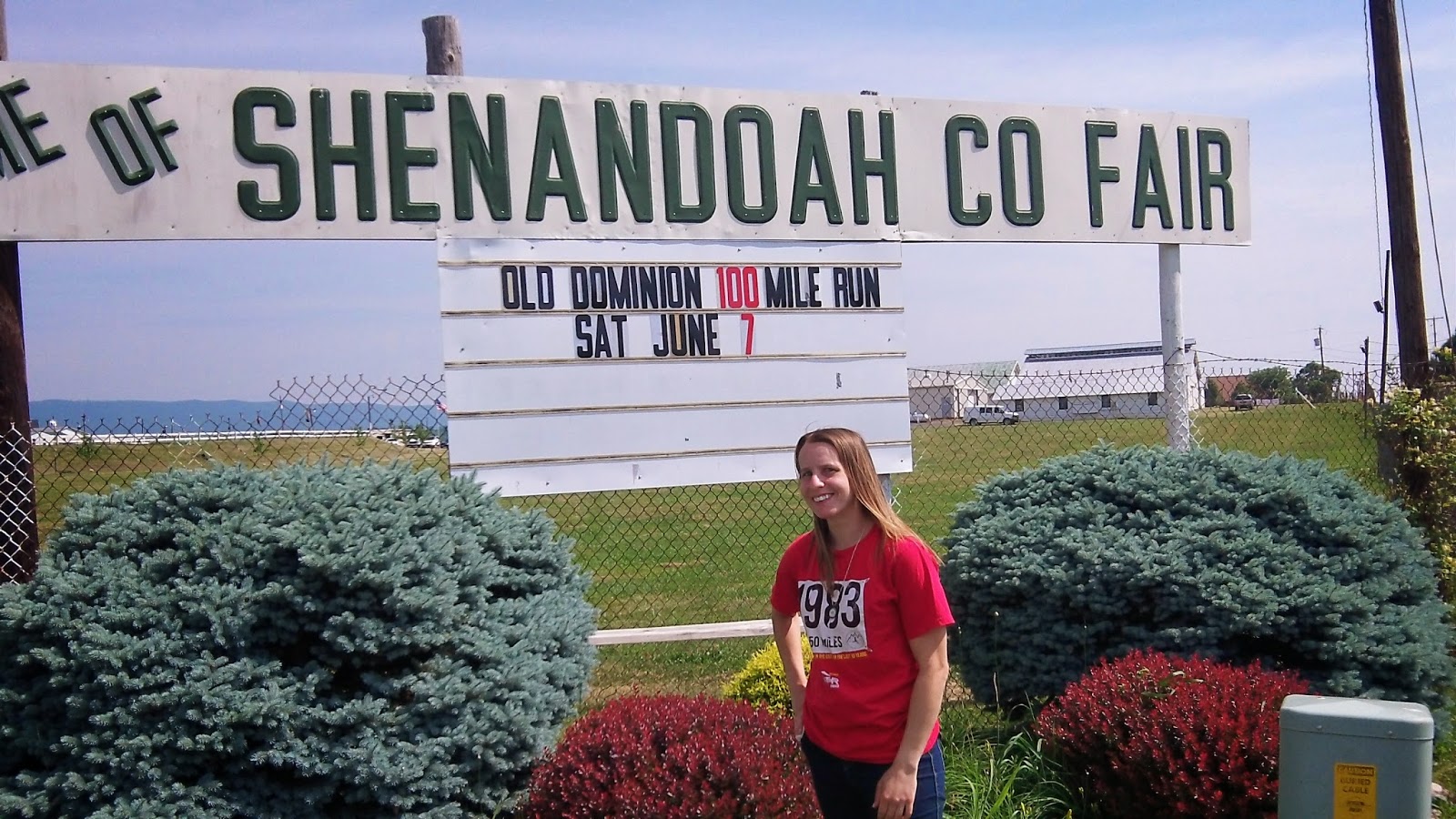
The day before the race, I met my crew at 12:30 so we could drive up to Woodstock. We loaded up the SUV with tons of food, gear, blankets, pillows, and everything else we could fathom needing for a whole weekend of running and crewing. We arrived at the fairgrounds around 4:15, and I checked in, picked up my race number, and was weighed. This is clearly a low-key event. My "race packet" was a brown paper lunch bag that contained my race number, a sticker with my race number for my crew's windshield, a paper with the names of all registered runners, and some samples of tea and coffee from a local business. The medical check consisted of weighing me and presumably, the doctor giving me a visual once-over and deciding I looked at least reasonably fit.
 |
| Melissa, me, and Kat. They were a phenomenal crew! |
Immediately after was the race briefing. This was Ray giving a description of the course, from memory, and a little bit of history of the race. It's clearly a family affair, and while the race remains small, they seem perfectly content to keep it that way. During the briefing, a monitor was playing a loop of photos with a photo from google earth of various sections of the race and their corresponding elevation profiles. I would love to see this added to the race website, as that would have been wonderful information to have before the race. The race briefing concluded with some basic instructions about the race start time, course markings, how to check in at the start, and the time of the awards breakfast. After the race briefing there was a crew briefing, but that really just consisted of making sure each crew had a copy of the Red Book and telling them to follow the directions listed there.
After the briefing, my mission was to eat and sleep. We went back to the hotel, and I ate the chicken and rice I had brought along, and while my crew picked up their own dinner I made some last minute notes and checked that everything was organized, my watch was charging, and my race day clothes were ready to go. I set my alarm and then went to sleep as early as I could.
At promptly 3am, my alarm went off and I started getting ready. I ate a big breakfast of chicken, rice, and scrambled eggs, along with a banana. Got my race gear on and talked to my crew about a few last-minute things. Time went quickly and before I knew it, it was 3:40 and we headed down to drive over to the race start. The excitement was palpable of course, I love that nervous energy that everyone has at the beginning of a race.


Pretty soon we lined up at the start and after a short prayer, we were off. A quick loop around the track, (I remember thinking, "this is going to seem like forever when we get back here") and we were off running through town. I spent the first few miles chatting with some other runners, and while it was faster than I had anticipated going out, we were still bringing up the rear. We were all commenting on how we thought we were making pretty good time and were surprised to have the follow car right behind us. Those first few miles went by quickly and soon we were climbing the switchbacks on the road up the mountain. The moon was bright and you almost didn't even need a headlamp. It was still cool, in the upper 50s, and this was a really nice climb. As we neared the top, you could see the lights of Woodstock in the distance, and it seemed hard to believe that we had just come from there.
Pretty soon we lined up at the start and after a short prayer, we were off. A quick loop around the track, (I remember thinking, "this is going to seem like forever when we get back here") and we were off running through town. I spent the first few miles chatting with some other runners, and while it was faster than I had anticipated going out, we were still bringing up the rear. We were all commenting on how we thought we were making pretty good time and were surprised to have the follow car right behind us. Those first few miles went by quickly and soon we were climbing the switchbacks on the road up the mountain. The moon was bright and you almost didn't even need a headlamp. It was still cool, in the upper 50s, and this was a really nice climb. As we neared the top, you could see the lights of Woodstock in the distance, and it seemed hard to believe that we had just come from there.
At the top of the climb was the first aid station. I didn't need to stop yet, so I just thanked the volunteers and set off down the gravel road. I knew the next section was mostly downhill, and with the cool weather and the sun now up, it was a great section of relaxed running. We maintained a pretty good pace through here, and before I knew it, we were at the Boyer aid station, ready to hit the first section of trail at mile 11. The trail section had some steep climbs, but they were over quickly and even the rocky downhill was decently runnable. Before I knew it, we were back to the Boyer aid station, and then heading down the road along the creek. It was still relatively cool, probably around 70 at this point, and we were running on a fairly shady road with no significant climbs. Another very enjoyable section to run. At the first crew access, mile 19.6, my crew was ready for me, all excited! I came up to a fully decked out mini-aid station, with pictures that my kids had drawn for me and a selection of snacks and drinks. My crew had me in and out so fast I didn't even realize I didn't grab my mp3 player until I had already started up the road. Oh well, I was feeling good at that point and didn't really need the distraction of the music.
It was all road to mile 32. These miles got gradually warmer, and as the roads got out into the valley were very exposed. The countryside was beautiful, running past horse farms and adorable little cottages, but this was the first section where I really started to feel hot. Many of the aid stations had ice, which I put in my shirt. The aid station volunteers were all very friendly and helpful, but the food selection was pretty minimal and I was thankful that I had brought a plethora of snacks to access at the crew aid stations. Coming into the second crew aid station at mile 32, I was feeling very good and still strong. I was excited to still be in a pack of other runners. Since I knew this was a pretty small race (I think there were 57 starters this year), I expected things to thin out quickly and anticipated running most of the race alone. Even though it was hot, the first section had gone by very quickly. I came to the aid station in a little over seven hours, comfortably ahead of my 28 hour pace.
 |
| Our mobile aid station, packed and ready to go |
It was all road to mile 32. These miles got gradually warmer, and as the roads got out into the valley were very exposed. The countryside was beautiful, running past horse farms and adorable little cottages, but this was the first section where I really started to feel hot. Many of the aid stations had ice, which I put in my shirt. The aid station volunteers were all very friendly and helpful, but the food selection was pretty minimal and I was thankful that I had brought a plethora of snacks to access at the crew aid stations. Coming into the second crew aid station at mile 32, I was feeling very good and still strong. I was excited to still be in a pack of other runners. Since I knew this was a pretty small race (I think there were 57 starters this year), I expected things to thin out quickly and anticipated running most of the race alone. Even though it was hot, the first section had gone by very quickly. I came to the aid station in a little over seven hours, comfortably ahead of my 28 hour pace.
 |
| Some of the aid stations had very good selections |
My crew filled up my water and snacks for the trail section ahead, and whisked me out so quickly that I left without my camera. This got to me a little bit; I had been excited about filming portions of the trail along the way especially to show my kids, and I knew this was a technical trail section with creek crossings that would be really interesting to see. I had to make some intentional mental choices to move past it, especially since I was far enough into the race to start feeling some fatigue. This section was tough, a lot of long climbs, some thick mud, a few creek crossings, and one tree crossing (the tree was down completely blocking the trail, requiring you to climb over the trunk and under a few branches). It turned out to be quite a bit different than I had run when I tried to train here; the route I thought was correct was much rockier and steeper, as it turns out the actual route is not as rocky or steep, but significantly longer and sunnier. It was a hot section, and I had to ration my water to make the 2 liters last for the entire 8 miles. Still, I made it to the aid station in good spirits, dunking myself in the creek just before getting weighed in. They had ice for me to put in my shirt again, and fruit, and the volunteers were very encouraging. I left feeling quite refreshed and enjoyed the almost 5 mile road downhill jog back to the aid station where my crew was waiting for me.
At this point, I had covered almost 48 miles, and was still feeling really great. I was ahead of my pace chart by over 30 minutes. I spent the last couple miles memorizing a list of what I needed, determined not to let my crew rush me, especially since I had time to spare. I came into the aid station reciting my list, and they took great care of me. I did make one mistake though-after changing my socks, I put on the wrong shoes.
The next section was hot and exposed. The trail section had offered a welcome reprieve from the sun, but this section was road again, and the combination of the heat of the day (full sun, in the mid 80s), the gradual uphill, and the fatigue of being on my feet so long started to take its toll. The shoes were rough on my feet and I started to feel blisters forming. I stopped a few times to clear any visible debris from my shoes but there wasn't much to be done until I reached my crew at the next aid station, about 8 miles down the road.
I arrived happy to see my crew and looking forward to changing shoes. I took a few minutes to put moleskin and tape on my feet, hoping to keep blisters at bay. I had lost a few minutes off my time in this section because of the blisters, but I was still ahead of my estimates. My crew told me I needed to hurry. I told them I was fine, but Kat said I had lost 20 minutes because a person I had been running with came in 20 minutes before me. I thought I had lost less, maybe he was running stronger.
The next section proved to be the mental low point for me. It was a pretty rough section of ATV trail, with lots of short steep hills and piles of rocks. I'm sure the unevenness of the trail and roughness of the terrain is great fun when you're on an ATV but it made for rough running. The blisters were uncomfortable, but I knew I could push through that. The real struggle was questioning whether I would be able to finish. Kat's well-intentioned comment had set off a flurry of self-doubt. What if I slowed down a lot more? What if the blisters kept me from running for a long time? What if I couldn't finish in time? I pictured having to come back and tell people I didn't finish...it was rough. But then came the turning point of the race for me really, when I consciously chose to not obsess over it, to not let her comment stick in my mind. I chose to focus on running to the next aid station as well as I could. I crunched the numbers over and over in my mind and was fully convinced that if I could arrive at Elizabeth Furnace (mile 75) by 10:30, I could basically walk the last 25 miles in 9.5 hours and still be an official finisher. And that still felt very achievable.
During this section there is a small aid station, which has apparently been unmanned in other years, but this year there was a friendly gentleman sitting by the piles of coolers. At such a mental low, and having run alone for many miles, seeing a live human was a great encouragement to me.

The next aid station was Little Fort, at mile 64. I saw my crew again here, they gave me my headlamp and were excited that the next time I'd see them would be at Elizabeth Furnace. I had spent the last few miles becoming entirely convinced that I had a great chance at finishing the race, and becoming determined to not listen to any messages about hurrying, so I honestly have no idea if my crew said anything like that to me. They refilled my snacks and water, and I set off to run the 11 miles to Elizabeth Furnace. This section was all road, but it was finally cooling off a bit as evening settled in, and it was the same gravel downhill we had run in the morning. While I wasn't quite as quick as I had been over 12 hours earlier, I did run quite well through here. I gained some time and ran better than I had for many miles. My legs felt the strongest they had since mile 30, and I really enjoyed this section. I was really starting to believe that I could finish the race. I had long ago decided that reaching Elizabeth Furnace meant I would finish, since I would have pacers who would not let me quit before mile 86, and then at that point I could always just walk down the mountain, even if it took me hours and hours. The confidence continued to grow as I ran harder. The only sad part was running down the gravel road, and three separate times I saw campfires and vehicles and got all excited to reach the aid station, only to find it was just some people up there camping for the night and the aid station was still further ahead.
Eventually, I did reach the Mudhole Gap aid station at mile 69.5. There was a whole group of kids here who cheered, and that really touched me. What a huge encouragement they were! Clearly there was a party happening at this aid station and I admittedly took a bit longer to get out of the aid station than I should have; the volunteers were just so helpful and cheerful. This was when I put my headlamp on; it was just getting dark and while the road had been doable by moonlight, this section involved several rocky creek crossings and was far too dark to do without a lamp.
After about a mile or so of criss-crossing the creek, we took an old service road that climbed up for quite awhile, then was a very nice runnable descent most of the way down to the aid station. About a mile before the aid station, the course split off on a side trail that was quite rocky and had a few steep climbs. This was my only fall of the day, as I scraped up my knee on a sharp rock. I could hear the aid station long before I could see it, but just as I wondered if I would ever get there, we crossed the main road, ran through a picnic area, and arrived at the aid station just before 10:30. My crew was ready for me! Elisa had come as well at this point, so she and Kat could hike with me. I took a few minutes to retape my feet, and put a bandaid on my knee. We made sure to have plenty of water and snacks, knowing the climb ahead would be quite difficult. But I felt really great, having arrived at my goal time and feeling pretty strong physically, far better than I had anticipated feeling at this point.
 |
| Mudhole Gap Trail (on a training run) |
After about a mile or so of criss-crossing the creek, we took an old service road that climbed up for quite awhile, then was a very nice runnable descent most of the way down to the aid station. About a mile before the aid station, the course split off on a side trail that was quite rocky and had a few steep climbs. This was my only fall of the day, as I scraped up my knee on a sharp rock. I could hear the aid station long before I could see it, but just as I wondered if I would ever get there, we crossed the main road, ran through a picnic area, and arrived at the aid station just before 10:30. My crew was ready for me! Elisa had come as well at this point, so she and Kat could hike with me. I took a few minutes to retape my feet, and put a bandaid on my knee. We made sure to have plenty of water and snacks, knowing the climb ahead would be quite difficult. But I felt really great, having arrived at my goal time and feeling pretty strong physically, far better than I had anticipated feeling at this point.
 |
| Waiting for me at the aid station |
 |
| Waiting at Elizabeth Furnace |
Typical terrain up Sherman Gap
(from a training run)
We climbed over Sherman Gap quite quickly, and in what seemed like no time we were down at the road. Melissa had come and parked over here (not official crew access point, ssshhhh) because Kat didn't think she'd be up to the whole 12 miles, but she decided to continue. We stopped briefly to fill up water bottles and then continued up the hill. This road section had felt like forever on a training run, but went by surprisingly quickly that night, and we found ourselves at the Veach East aid station. They were having a great time out there, fabulous volunteers. They gave me some ginger chews and we headed up the next climb.
 |
| Sherman Gap summit |
Again my pacers wanted to hurry hurry hurry, and while I very much appreciate what they were trying to do, I just physically wasn't up to that pace and started having the worst stomach issues I'd had all day. Physically, this was the worst I felt the entire race. The terrain is challenging and it's a long climb, but no worse than the other trails we run often in the mountains. I think it was mostly that I was going too quickly for the strength I had at the time. Even so, I did very much enjoy their company, since I had run most of the last 50 miles or so alone. And I was glad to have two people with me, because even when I didn't feel like talking, they could talk to each other and just listening helped take my mind off the climbing. They were very encouraging and kept reminding me of how far I had already come, and very much believed that I would be able to finish. That helped a lot.

The climb up to Veach Gap in daylight
(from a training run)
Finally, we reached the Veach West aid station around 3am. I was so happy to know that the toughest sections were all behind me, and all that remained of the course was less than 14 miles of roads. I had to leave my safety runners, and Elisa went home after this section, but I had been so grateful for their company. Physically, I was still feeling pretty rough from pushing so hard up and over the mountains. I decided to walk for a bit to try to regain control of my stomach, especially since I had 5 hours to cover 14 miles. No need to rush.
At this point, I'm not sure what happened. Maybe it was because I was feeling so awful physically and concentrating on keeping my stomach together. Maybe it was they physical exhaustion of being awake and on my feet for 23 hours straight. Maybe it was just confusion from being alone in the dark in an unfamiliar place. But whatever it was, whatever happened, I somehow took a wrong turn. I noticed that it had been a little while since I saw a chem light, but I remembered Ray talking at the race briefing about how people often take the chem lights off the roads back into town and they will work to replace them, but it's not unusual for them to be missing. So I continued for a little while, but gradually got more concerned. I wasn't a very good judge of time or distance at this point. I tried to turn around, but I got disoriented at a three way intersection and wasn't 100% sure which way I had come from. Of course, I didn't have my index card with turn-by-turn directions, that had been forgotten at the last aid station. I briefly considered knocking on a door, but then remembered that it was 4am and that would likely not be appreciated.
I had studied maps of the course quite a bit before coming, and knew that I was heading back up to the road that would lead me back to the course. I figured I was taking the long way around, and may have to backtrack a few miles, but I knew if I kept going that direction I would eventually reach the course. I was concerned, because this race demands that you return, under your own power, to the point where you left the course, in order to be counted as an official finisher. I knew I had some extra time, but my concern was that I honestly had no idea where I had left the course. Once again I had to make some conscious mental choices to stay in the race and not lose myself in the what-ifs, but honestly this wasn't too difficult somehow, maybe because I knew I'd eventually get back on course and wasn't completely and hopelessly lost in the woods.
My plan, if you can call it that, worked. I found myself at the sign that says mile 93 left, mile 65 right. Only I came at it from the wrong way, and had skipped an aid station. At least now I was seeing runners again, even if they were coming from the other direction. I asked one how far the aid station was, and he said maybe a mile. Then an SUV pulled up, one of the race director's people. I talked to him about what happened, and he said that if I went down the hill and checked in at the aid station, I could continue and finish. That was a huge relief! At least I knew where I was and where I needed to go now. I had done an extra 4 miles, but it could definitely have been worse and I still had plenty of time.
I ran down the hill and checked in. The lady was quite confused and seemed to think I had already been there. Oh, my friend, I can assure you that while I have been looking for you for a long time, I have not been here. I suspect that it was the lady with number 28 (I was 29), who had been through recently. At any rate, I continued, knowing that I had now covered more than the full course. I ran back up the hill. One of the blisters on my feet popped, which caused a few minutes of sharp pain but I retaped it the best I could and continued on. I was determined to get down the mountain, especially now that I had overcome getting lost.
One more aid station at the top of the hill. I thanked the volunteers and started down the mountain. The sun was now coming up, and it was a really nice morning. I wished my legs had been just a bit stronger so I could run the whole thing, but I still was able to run quite a bit. I took note of the landmarks on the way down-the National Forest sign, the road turning from dirt to paved, the last switchback, the dam. I took special note of completing 100 miles on my watch at just after 6am. Soon I was hiking up the last long hill towards town and the final aid station. It seemed like I would never get there, but of course I did. And there was my crew! Somehow they weren't overly concerned about my arrival time and were surprised when I told them I was already at 101 miles. I happily shed my pack and just took my water bottle for the last leg of the race. They told me my husband and kids were waiting at the finish. And I insisted on getting my index card-I refused to risk any more wrong turns on the way back to the fairgrounds. I think my crew realized I was really serious about that, because they drove slowly enough to lead me through the turns on the way back.


Running up Water Street, we passed the farm, and the pungent aroma of cows filled the air. I have never been so happy to smell cows in all my life! I almost began to cry, because this was such an obvious landmark and I knew I was so close, and I was really going to finish.
If anyone had followed me through town, they would have thought I was completely nuts. I was talking to myself the entire time, reciting the names of the roads I needed to turn on and focusing on reading and rereading every street sign. Plus I was pretty emotional at the thought of my kids waiting for me at the finish. I walked a lot of this part, because I was determined to run the lap around the horse track when I arrived.
For such a small town, Woodstock sure had some long miles back to the fairgrounds, but eventually, finally, there in the distance I could see the fairgrounds and the exhibition building where the race was headquartered. So exciting!! As I came in, I saw my crew, my kids, my husband, and a few other people, who cheered for me as I came through the gate. I still had a long lap to run around the track, but I ran the whole thing as hard as I could. My kids were holding up signs for me near the finish. Ian had come up about 50 yards to hold his sign, and I had him run to the finish with me. They held up the tape so we could cross the official finish line. My watch read exactly 104 miles in 27 hours, 7 minutes.
 |
| Cutest signs ever! How could you not keep running? |
 |
| My watch, with bonus miles |
I did it! I really really did it! Exhilaration, fatigue, excitement, celebration, and many other emotions were all twisted and tangled in the moments after the finish. I talked to my family and friends, they congratulated me, we cheered in another runner a few minutes later, I talked to a few other runners and their crews....my head was spinning but in the best way possible. Eventually I went back to get a shower before the awards breakfast started at 9am.
My dedicated crew left at this point to get back home, so I thanked them many times over for all their extraordinary help over the weekend. The confidence they gave me was invaluable, they took fabulous care of me, they never complained about all the driving or lack of sleep or setting up and tearing down at every aid station, they did everything for me that they possibly could and I am incredibly grateful for them.
After an abbreviated ice bath and short shower, I headed over to the awards breakfast. While the race is certainly held with the 24 hour goal as the focus, under 28 hours are official finishers. All finishers get a very nice duffel bag, and the 24 hour finishers also get the infamous belt buckle. The race is small enough that each finisher got to talk. They went from the slowest to the fastest. Since I was one of the slowest, that meant I got the combination of the least amount of sleep (none) with the least amount of preparation time for my speech, so I'm not sure how coherent I was and I forgot many of the things I would have loved to have said. But as we got closer to the winners, who had at least had a nap, if not slept for much of the night while I was on the other side of the mountain, the comments got more coherent and more interesting.
There were a few common themes; most notably, the "Wow, did I ever underestimate this race course, it was much tougher than I anticipated it being" and the "I really heard this race was not well supported and the aid stations were hit or miss, but actually it was very well run and I was impressed." I would agree with both those sentiments; with the exception of the one course snafu (which I think I was the only one to do, so it was probably just my own delirium), it was adequately marked. Some aid stations were lacking a little, but other aid stations were fabulous. I do think it would be possible to run this race with just the drop bags, although having a crew made it immensely easier.
Overall, I thoroughly enjoyed this race. I especially liked how much more mental strategizing went into this race. I feel like the short races are really about brute athleticism, which I lack. There isn't really much strategy in a 5K race, other than run as fast as you can. But this race, even compared to a 50 miler, had a lot more strategy-the run/walk decisions from the very beginning, how to pace yourself, how to stay on top of eating and drinking, and how to handle challenges. In a race that long, you're going to encounter something challenging-weather, terrain, blisters, knee/ankle issues, stomach issues, fatigue, mental lows, getting lost, missing a time goal-as much as possible, I planned for every issue I could anticipate, so if/when they arose, I already knew what to do and had any supplies I needed no later than the next crew location. I feel like this race played very well to my strengths-mental fortitude, stubborn determination, and indifference to physical discomfort. Short of a broken bone, I was not going to quit this race, and my mind was steadfastly made up to that effect before I ever crossed the starting line. There were people there who DNF'd but who were far more athletic than me-better runners, faster runners, more experienced runners. I think the only thing I had more of was stubbornness.
Two days later, I'm amazed at how good I feel honestly. I expected to be practically immobile and exhausted, but actually I feel great. I drained the blisters, so they feel much better. My muscles feel great-no soreness, just a little fatigue. The only exception is one knee which has been quite swollen and red and a bit sore. Otherwise I feel fabulous. That shocks me really. I felt much worse after my first 50K than I do now.
I would love to go back to Old Dominion. I honestly went into this race expecting a sub-par event, but ended up being very impressed at the number and quality of the volunteers out there, the accessibility of the aid stations both with and without crew access, and the variety of the course. Although there are a lot of road miles on this course (55 miles unpaved, 10 miles paved according to the official stats), it didn't feel monotonous. I notoriously avoid roads and only run trails, but most of the roads felt more like wide, easy trails. There were a lot of rolling hills and beautiful scenery so it didn't feel so long. And the trail miles were very challenging, which I enjoyed. Rocky, steep, and wet-but gorgeous trails that are well-maintained. A crew is invaluable at the race, but not a necessity-drop bags were available fairly frequently, so with the right planning, you could run this race without a crew. I'm hoping to go back next year and try again, if possible with my crew. You ladies available? :)
I feel like my training prepared me well for this event. I was well-trained, but not over-trained. I felt rested coming into the race, and had no nagging injuries. If I ran another hundred miler, I would probably train similarly, with the exception of training tailored to the specific course. For example, if I ran Old Dominion again, I would work more on running downhill roads harder to gain more time there. I feel like I hiked very well, but could have made up a lot more time on the runnable sections. I also feel like I did a good job fueling-constantly eating throughout the day, lots of items like tortillas with chicken and rice, fruit, peanut butter and jelly sandwiches. Even if I didn't particularly feel like eating I continued to do so, and I think that kept me from ever bonking in the 27 hours.
The main thing I would change if I ran another hundred would be how I approach my crew. The first time these awesome ladies crewed me, it was for Mountain Masochist and I knew I'd be riding the bubble on time cutoffs for that race. They got me in and out of aid stations with lightning speed, and pushed me hard when pacing, which is exactly what I needed for that race. When I asked them to crew me for this one, I wasn't sure what to expect for time. 28 hours is on the short side for 100 mile races, and while my pace chart felt conservative I had no idea how much I would slow down after 50 miles. As it turns out, I was able to keep a pretty steady pace, and I wasn't nearly as rushed as I had anticipated. So looking back, I wish I would have taken more time at the aid stations, and let my crew know that while time is still of the essence, there is time to take a minute or so and just double-check that I have everything I want. I left the first two aid stations without items I intended to bring with me, and the third aid station in the wrong shoes. I made turn by turn direction cards with section notes, but many times left the aid station without them, including when I went off course. These are all things I had written down, but my crew was doing such a great job getting me back on the trail that we didn't stop to check. Similarly, I should have expressed more clearly to my pacers before the event how much of a buffer was built into the time for that section. They wanted to bank me time, which I very much appreciate and love their hearts to come out and push me in the middle of the night, but I wasn't quite strong enough at that point and I think it may have contributed to my mental state being such that I went off course right afterwards. If I had made that clearer before the race, they would have known that I meant it and I wasn't just complaining because I was tired. In shorter races, it is absolutely worth rushing out as quickly as possible, but because of the length of the race, I think I would have done better to take an extra minute at each crew aid station to be sure I had what I needed, and possibly minimized blisters and leaving the course which cost me far more time in the end.
I had the support of so many fabulous people to be able to run this race. Thank you to Jeremy, who watched our kids every Saturday for months so I could get long runs in. Thank you to my amazing crew, Kat and Melissa, who spent their entire weekend supporting me, getting to every aid station on time and with all my supplies at the ready, eager to help me with whatever they could and to cheer me on. Thank you to Kat and Elisa, who ran with me in the middle of the night over the most challenging terrain of the race, and kept me in good spirits and my mind off the task at hand, making those miles go by quickly. Thank you to the race directors and volunteers, who put on a fabulous race. Thank you to all my running friends, who have made training even more fun than the races themselves. I love being a part of this community!
I would love to go back to Old Dominion. I honestly went into this race expecting a sub-par event, but ended up being very impressed at the number and quality of the volunteers out there, the accessibility of the aid stations both with and without crew access, and the variety of the course. Although there are a lot of road miles on this course (55 miles unpaved, 10 miles paved according to the official stats), it didn't feel monotonous. I notoriously avoid roads and only run trails, but most of the roads felt more like wide, easy trails. There were a lot of rolling hills and beautiful scenery so it didn't feel so long. And the trail miles were very challenging, which I enjoyed. Rocky, steep, and wet-but gorgeous trails that are well-maintained. A crew is invaluable at the race, but not a necessity-drop bags were available fairly frequently, so with the right planning, you could run this race without a crew. I'm hoping to go back next year and try again, if possible with my crew. You ladies available? :)
I feel like my training prepared me well for this event. I was well-trained, but not over-trained. I felt rested coming into the race, and had no nagging injuries. If I ran another hundred miler, I would probably train similarly, with the exception of training tailored to the specific course. For example, if I ran Old Dominion again, I would work more on running downhill roads harder to gain more time there. I feel like I hiked very well, but could have made up a lot more time on the runnable sections. I also feel like I did a good job fueling-constantly eating throughout the day, lots of items like tortillas with chicken and rice, fruit, peanut butter and jelly sandwiches. Even if I didn't particularly feel like eating I continued to do so, and I think that kept me from ever bonking in the 27 hours.
The main thing I would change if I ran another hundred would be how I approach my crew. The first time these awesome ladies crewed me, it was for Mountain Masochist and I knew I'd be riding the bubble on time cutoffs for that race. They got me in and out of aid stations with lightning speed, and pushed me hard when pacing, which is exactly what I needed for that race. When I asked them to crew me for this one, I wasn't sure what to expect for time. 28 hours is on the short side for 100 mile races, and while my pace chart felt conservative I had no idea how much I would slow down after 50 miles. As it turns out, I was able to keep a pretty steady pace, and I wasn't nearly as rushed as I had anticipated. So looking back, I wish I would have taken more time at the aid stations, and let my crew know that while time is still of the essence, there is time to take a minute or so and just double-check that I have everything I want. I left the first two aid stations without items I intended to bring with me, and the third aid station in the wrong shoes. I made turn by turn direction cards with section notes, but many times left the aid station without them, including when I went off course. These are all things I had written down, but my crew was doing such a great job getting me back on the trail that we didn't stop to check. Similarly, I should have expressed more clearly to my pacers before the event how much of a buffer was built into the time for that section. They wanted to bank me time, which I very much appreciate and love their hearts to come out and push me in the middle of the night, but I wasn't quite strong enough at that point and I think it may have contributed to my mental state being such that I went off course right afterwards. If I had made that clearer before the race, they would have known that I meant it and I wasn't just complaining because I was tired. In shorter races, it is absolutely worth rushing out as quickly as possible, but because of the length of the race, I think I would have done better to take an extra minute at each crew aid station to be sure I had what I needed, and possibly minimized blisters and leaving the course which cost me far more time in the end.
I had the support of so many fabulous people to be able to run this race. Thank you to Jeremy, who watched our kids every Saturday for months so I could get long runs in. Thank you to my amazing crew, Kat and Melissa, who spent their entire weekend supporting me, getting to every aid station on time and with all my supplies at the ready, eager to help me with whatever they could and to cheer me on. Thank you to Kat and Elisa, who ran with me in the middle of the night over the most challenging terrain of the race, and kept me in good spirits and my mind off the task at hand, making those miles go by quickly. Thank you to the race directors and volunteers, who put on a fabulous race. Thank you to all my running friends, who have made training even more fun than the races themselves. I love being a part of this community!
Subscribe to:
Comments (Atom)